
In that special day, thousands of astronomers from around the world came to Indonesia to witness a rare celestial event: a total solar eclipse. I call them eclipse hunters—people who travel to the far corners of the earth, chasing shadows and light, wherever the path of totality takes them.
In that special day, thousands of astronomers from around the world came to Indonesia to witness a rare celestial event: a total solar eclipse. I call them eclipse hunters—people who travel to the far corners of the earth, chasing shadows and light, wherever the path of totality takes them.
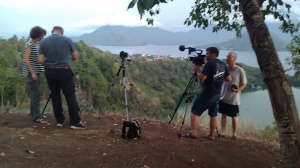
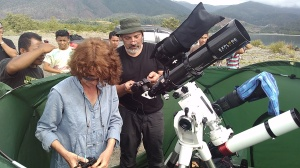
Among them were Gernot and Pascal, a couple of seasoned astronomers from Germany. As an Indonesian fixer, I had the opportunity to follow their journey alongside a German television crew producing a documentary about the sky, astronomy, and the human passion for understanding the universe. Gernot and Pascal were the main characters in the film—and in many ways, in this unforgettable journey.
For years, they’ve crisscrossed the globe in search of eclipses, venturing into remote places like the North Pole and even flying into space with NASA. They had already come to Indonesia back in 1983, when a total eclipse swept across Java.
But for Gernot and Pascal, it’s never just about the eclipse. What brings them joy, they told me, is sharing these rare moments with local communities. Witnessing the wonder in people’s eyes—especially children seeing the sky transform for the first time—is what truly matters to them.
That made this project special for me, not just working as an Indonesian Fixer, but I’ve always been fascinated by astronomy, so being part of this journey felt both personal and inspiring.
Out of all the possible eclipse paths in Indonesia, Gernot and Pascal chose to observe it from North Halmahera—not only because it offered the longest duration of totality, but also because of its stunning natural landscapes, rich history, and vibrant local culture.
We started in Ternate, spending the first day scouting the island. It only took about an hour to drive around the coast, but the scenery felt endless—every turn revealing another postcard-perfect view.
Mount Gamalama towers behind the city like a watchful guardian, while the Maluku Sea stretches out in front like an open canvas of blue. We were drawn to a secluded villa on the mountain’s slopes, which turned out to be a private retreat belonging to the Sultan of Ternate. The main palace, now a popular tourist destination, is located in the heart of the city.
From the villa’s terrace, the entire city unfurled along the coastline. Facing east, it felt like the perfect place to watch the sun rise—maybe that was the Sultan’s idea all along. That morning, the view was pure magic. We flew our drone from the terrace and captured Ternate from above, bathed in soft light.
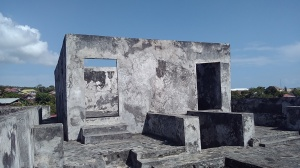
Our next stop was the island’s historic forts. Scattered across Ternate, at least eight bastions from the colonial era still remain, although many are in ruins. The most intact ones—Tolukko, Kalamata, Kastela, and Fort Oranje—stand proudly along the shoreline, once built by Portuguese and Dutch forces as military lookout posts. Their European-style architecture adds a layer of mystery to the island’s landscape—and they also make ideal spots for observing the sky.
In one village, we came across cloves drying along the roadside for what seemed like kilometers. The scent was intoxicating. “Centuries ago, the Portuguese, Spanish, Dutch, and British came here just for these,” a clove farmer told us with a smile. It was a simple but powerful reminder of how much history this small island holds.
As the eclipse day approached, Ternate filled with excitement. More astronomers and tourists began arriving—over two thousand foreign visitors, the local government said, from countries like the U.S., Germany, Russia, France, Japan, and across Asia.
But the growing crowds made Gernot and Pascal reconsider their location. “We want to be somewhere quieter, where we can interact with local students and villagers,” Gernot explained. So we changed course. As an Indonesian Fixer, I understand that Indonesians love interacting with foreigners, especially wanting to take photos together, and of course this can be very distracting when we are working on something serious.
The next morning, we boarded a ferry to Sofifi, on the island of Halmahera. The water was crystal clear, and schools of colorful fish swam beneath the dock like in an aquarium. Midway through the crossing, Pascal excitedly photographed a pod of dolphins leaping beside the ferry—yet another unexpected gift from nature.
From Sofifi, we drove toward the town of Maba, on North Halmahera’s eastern coast. The road twisted through lush forests and rolled alongside stretches of untouched white sand beaches. The view from the hilltops, where the sea met the sky in seamless blue, left us all in quiet awe.
Gernot and Pascal were carrying over 300 eclipse glasses to distribute to local schoolchildren. So while some scenic hilltop locations looked perfect for observation, we needed to be near a village or school.
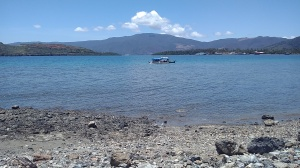
After nearly ten hours of driving, we arrived in Maba—a small, remote town with just enough modern comforts: a decent hotel, internet, a supermarket, and even a café with free Wi-Fi. There’s also a small airport nearby, mainly serving workers from the local nickel mining industry.
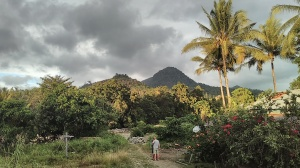
The next day, we continued our search and eventually discovered a place called Tanjung Geropong in the village of Mabapura. It was beautiful—open, serene, and not far from an elementary school. Gernot and Pascal visited the school, handing out eclipse glasses and inviting the students to view the sun through their special binoculars. The kids were thrilled. Their laughter and curiosity lit up the day.
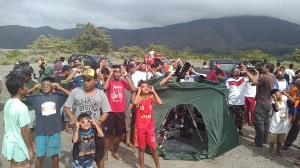
The night before the eclipse, Gernot set up camp at the observation site. By morning, Pascal arrived to find dozens of local people and students already gathered, buzzing with anticipation.
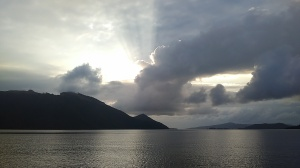
Tanjung Geropong is usually quiet, visited only by passing fishermen. But on that day, it came alive. Families, students, and local tourists filled the cape. “I never realized how beautiful this place is,” said a mother who had brought her children.
The beach shimmered. Fish darted between coral reefs. Traditional fishing boats bobbed on the horizon. And then, slowly, the moon began its dance across the sun.
Bit by bit, the light dimmed. Morning turned to twilight. The ocean glowed silver. Then—totality. For nearly four minutes, the world slipped into darkness. Everyone fell silent, watching the sky with wide eyes. Then, as sunlight returned, cheers erupted from the crowd.
This journey wasn’t just about filming a solar eclipse. It was about discovery—of landscapes, of people, of moments that connect us through wonder.
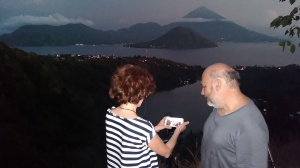
For Gernot, Pascal, and the rest of us, chasing the eclipse in North Halmahera gave us more than scientific data or beautiful footage. It gave us stories. It gave us memories. And it reminded us of how deeply human it is to look up at the sky together—and feel something bigger than ourselves.
