

Working as a fixer for foreign productions, while also serving as a producer-director for my own projects, has given me a deeper understanding of what productions generally hope for or need the most.
Would you agree with me that each project typically expects an ideal set of conditions, such as:
We could probably add a few more expectations to this list:
Basically, we all want every aspect of the production to succeed, right?
However, as a fixer or local field producer, I’ve realized that there are many situations or conditions on location that we simply can’t fix or change. We often have to work around unpredictable or fluid circumstances, and I need to be able to anticipate and resolve problems—or potential problems—as they arise. This has helped me understand that striving for the best is sometimes not enough to create a successful production.
Below are some of my field experiences, which I hope will give us more insight into the importance of thorough pre-production preparation, as well as the value of flexibility and responsive adaptation on location.
Emergency Situation, Safety, and Fast Decisions: Essentials for Remote Filming
When a crew member gets scratched by a poisonous tree deep in the Sumatran rainforest, when a cameraman suddenly gets diarrhea at high altitude on a volcanic mountain, or when a producer comes down with a high fever on a remote island—what can I do? What if all the porters go on strike and threaten to leave us?
In situations like these, I’ve learned that we need to respond quickly and make fast, clear decisions to solve the problem.
That’s why it's so important to identify potential problems before they arise and prepare solutions in advance. We need to ask ourselves:
When Gear Goes Wrong in the Middle of Nowhere
I couldn’t find my important lense (I thought they’d be easy to find it in Indonesia). My tripod stand broke during the flight. My brand-new drone suddenly won’t land. I just realized I need spare batteries. We probably need an umbrella and a mosquito net. We’ve run out of duct tape. I think we need more LED panels or a Kinoflo. Oh no—my lens adapter (converter) isn’t in my luggage. The solar panel isn’t working properly, so now we need a small generator. My cameraperson couldn’t get their visa in time. Our source/contributor just canceled the appointment. My soundman needs a new cable and boom pole… and the list goes on.
In Jakarta, we could probably fix most of these problems pretty easily. But not in other parts of Indonesia.
And if these issues happen in the forest, on a remote island, or in the mountains—it could be a disaster.
Still, no matter what, we have to solve these problems with minimal stress (or as we say, with minimum "pain in our ass"). We can prepare everything thoroughly, but there's always a big chance that something unexpected will happen during production.
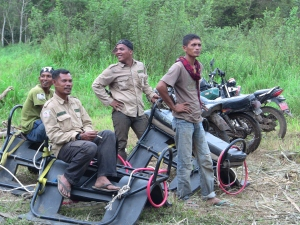
Adapting on the Fly: The Fixer’s Role in Unpredictable Shoots
"We’ve been walking for four days and still can’t find any wild elephant.”
“We need a bigger river for better filming.”
I don’t think this art performance fits the program or meets our show’s needs."
"I believe we need a different endangered flower—this one is too small."
"Can we arrange for two horses so we can film them together?"
"We can’t get steady shots in this fast-moving river; we’ll need to find another one."
"Do you think it’s safe to meet with those ISIS jihadist supporters in their area?"
"All the refugees we’ve met so far are not asylum seekers—we’ll need another character, or the story won’t work."
These are just a few examples of situations I’ve encountered in the field.
Some productions didn’t involve me from the beginning—as a researcher or local producer—so I joined in during the middle or final stages. But when changes like these come up during production and need fixing, I often have to take the lead and take on more responsibility to find a solution. That’s the fixer’s job, right?
That said, in many cases, the producer or director also brings great ideas or solid plans. In those situations, my role is to provide them with a comprehensive overview of the situation and present alternatives. Then I follow up and focus on execution.
That, to me, is what makes a great team.