

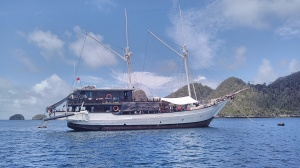

They call her Puti Raja—the “King’s Princess.” For five incredible days, she was our floating home as we sailed through the legendary waters of Raja Ampat in Papua, Indonesia, on a mission to track and film one of the ocean’s most graceful giants: the manta ray.
Raja Ampat, often hailed as one of the best diving spots in the world, isn’t just a diver’s paradise—it’s also a vital habitat for different species of manta rays. This journey followed an international research team from Conservation International Indonesia, who’ve been working to map and protect manta populations in the region.
I was on board as a fixer and local production coordinator, working with two Canadian filmmakers and an Australian underwater videographer. Together, we were documenting this expedition for a TV series called Great Blue Wild, a marine wildlife show broadcast in Canada and the U.S.
It took just an hour by speedboat (powered by a roaring 350-horsepower engine) to get from Kri Island to the Puti Raja. We were greeted warmly by Captain Johanna, a spirited 55-year-old Javanese woman, and her husband Kenny—an American who's been working these waters for years.
Kenny originally bought Puti Raja as a cargo boat and transformed it into a liveaboard vessel in Makassar, South Sulawesi. Now it has air-conditioned cabins, clean toilets, a living room, an open-air dining area, and plenty of space to lounge and relax. It’s no luxury cruiser—but for ocean adventurers like us, it’s more than enough.
Rita, our producer-director, admitted this was her first time living on a boat for more than a day. For me, it wasn’t exactly my first time—but usually, it’s just a quick one- or two-day trip, not a full week like this expedition. Most of my experience filming wildlife has been deep in the Indonesian forests, tracking animals on land. This time, I was “hunting” big fish in the open sea. A whole new adventure—and I was excited.
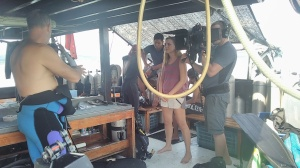
When we boarded, the research team was already prepping gear. The project was led by Mark Edman, a senior scientist and manta expert from Australia. Their goal: tag new mantas with transmitters and retrieve data from existing acoustic receivers that had been placed months ago on the coral reef.
Our crew’s main job was to film the moment a manta was tagged—a dramatic underwater scene where divers chase down a six-meter-wide fish through the depths, armed with tagging gear. We were hoping for something cinematic, like a high-speed underwater ballet.
Mark’s team had ten new transmitters and four acoustic receivers ready. According to Abam, one of the team’s researchers, they had already tagged about 90 mantas across Raja Ampat and installed 18 receivers to track their movements. They also used satellite tracking to complement the data.
Mantas are gentle giants. They glide near the ocean’s surface, feeding on plankton and tiny fish. Their size and elegance make them an unforgettable sight—and a real challenge to film.
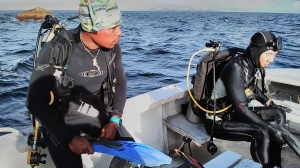
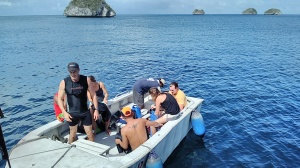
The next morning, three dive teams set out to find and tag mantas. Kay was assigned to film Ronald and Edy’s team. I tagged along on their speedboat, captained by Michael, who told us mantas often swam right up to people when feeding on the surface.
Kay, Ronald, and Edy dropped into the water, and Michael and I waited above. After over an hour, Ronald surfaced, holding up the tagging spear—still loaded. “No luck,” Kay said, climbing back aboard, looking tired.
Meanwhile, Mark and Sarah, diving elsewhere, had already tagged three mantas.
The afternoon dive brought more of the same. Kay stuck with Ronald and Edy, but again, they saw nothing. Mark and Sarah, on the other hand, tagged two more mantas—some say Mark’s scooter gave him an edge in chasing the fast-moving fish. Kay brought his too, but it malfunctioned just when he needed it most.
As Kay said, “When filming wildlife, always bring a spare—of everything.” Even in paradise, tech fails.
Day three started slow. Mark’s team dove while we stayed on the Puti Raja, passing time with coffee and card games. In wildlife filmmaking, waiting is part of the job. “Waiting is working,” we say. It reminded me of spending days on a one-meter platform 50 meters up a tree in Sumatra, waiting for orangutans to appear.
Later, we headed to Wayag, one of Raja Ampat’s most iconic spots. Towering rock islands, lush and green, surrounded by turquoise water. Kay flew his drone, capturing jaw-dropping shots from the air—no hiking required.
Still, no mantas today. “It’s always like this when film crews show up,” Abam joked. He’s worked with National Geographic, BBC, and others—so he knows the curse of camera presence.
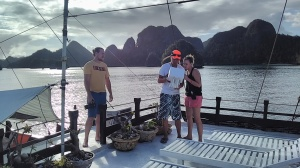
That night, we moved to Piai Island, where sea turtles come to lay eggs. The waves were brutal—everyone, even seasoned divers, got seasick. We anchored about a kilometer from shore and rode a speedboat to a tiny turtle research station run by Gad and his small team.
I was amazed they could live there for months, far from civilization. We dropped off equipment, interviewed Gad, and headed back to the boat, planning to return later to witness a turtle laying eggs.
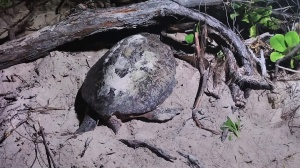
After dinner, Gad called us on the radio—"A big turtle just landed." We rushed back, trying to be quiet and respectful. “You’ve got 30 minutes before she starts laying,” Gad said. Funny enough, every time I asked about time, his answer was always “30 minutes.” No one wore a watch. Time had its own rhythm here.
We filmed from 8 PM to almost 12:30 AM. A slow, patient process. Digging, laying, burying, leaving. Gad told me a single turtle can lay 100–170 eggs in one night. I lost count watching her. According to Gad, six of the world’s seven turtle species are found in Indonesia—a fact I didn’t bother to fact-check. I liked the sound of it.
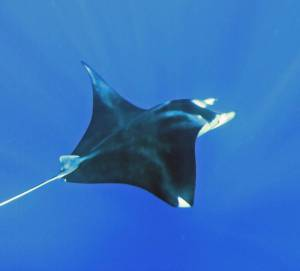
On day four, Kay finally got his moment. He filmed Sara tagging a manta—clean, crisp footage. After all the frustration, this was our big win. In wildlife filmmaking, persistence pays off. Sometimes, luck follows those who just keep showing up.
Rita looked relieved. As a producer-director, she carried the weight of the project. I could relate—having produced my own films, I knew exactly what she was feeling. That shared experience always strengthens a team.
Later that evening, things got serious. Abam and Abdi had gone 35 meters deep when they realized they were nearly out of oxygen. They surfaced too quickly, which can be fatal.
Mark acted fast, giving them pure oxygen and forcing them to drink water to help flush out nitrogen. “Keep drinking—even if you have to pee every five minutes,” he told them. In remote places, knowing what to do in emergencies is just as important as the dive itself.
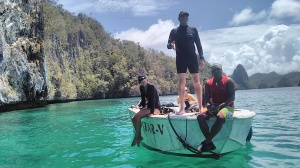
On our last day, we anchored near Ronald’s village. This was his backyard—literally. He’s logged over 2,000 dives, growing up with the ocean in his blood.
We headed to two of the best manta spots—Manta Ridge and Manta Sandy. Kay joined one team, and of course, they saw nothing. The other team? They saw two huge mantas… but too fast to tag.
And that’s wildlife. No guarantees, just stories.
As the sun dipped behind the islands, casting a red glow on the water, we said goodbye to Puti Raja—tired, salty, and filled with new memories. We’d gotten the shots we needed. We’d seen parts of the world most never will. And we learned, once again, that nature doesn’t follow a script—but if you’re patient, she might just let you be part of the story.